The decision takes seconds
Picture the actual moment your website gets used. Someone’s hot water system has failed, or there’s water coming through a ceiling. They’re standing in it, on a phone, and they search. They don’t read. They tap the first result, glance, and if the page doesn’t load or the number isn’t immediately obvious, they hit back and tap the next one.
That whole sequence takes a handful of seconds, and it’s where plumbing websites are won and lost. Not on the design, not on the copy, but on whether the page rendered before their patience ran out, and whether the number was the first thing on it.
This is why load time isn’t a technical nicety for a plumber. A site built on a page builder with a dozen plugins can take several seconds to become usable on mobile data. That’s long enough to lose an emergency job to whoever loaded faster, and it happens silently. You never find out the enquiry existed.
Emergency work and planned work are two different customers
Plumbing demand splits cleanly in two, and most plumbing websites are built for only one of them.
The emergency customer wants a phone number and a promise about how fast you can get there. They will not fill in a form, they will not read about your values, and they will not compare three quotes. Speed and availability are the entire pitch.
The planned customer, after a bathroom renovation, a hot water system replacement or gas fitting for a new kitchen, behaves completely differently. They’re researching over days, comparing, and they will read. They want to understand the options, see what similar jobs cost, and know what’s involved before they commit.
A site that only serves the first customer looks thin and pushy to the second. A site that only serves the second loses the first before the page finishes loading. The structure has to hold both: an urgent path that’s impossible to miss at the top, and genuine depth further down for people who are still deciding.
Six job types, six front doors
Blocked drains, burst pipes, hot water systems, leak detection, gas fitting and backflow prevention are separate searches, with separate urgency, made by separate people. Collapsing them into one “Our Services” list with six bullet points means competing for none of them properly.
Each job type deserves its own page: what the job usually involves, what affects the price, how long it takes, what someone should do before you arrive. That last part matters more than it sounds. A page that tells someone with a burst pipe where their water meter is and how to shut it off has already helped them before you’ve spoken, and that’s the page they’ll call from.
It also compounds. Six real job pages give you six ways to be found, six pages that can rank for “[job] [suburb]”, and six places to answer the questions you’d otherwise repeat on the phone.
Licensing, insurance and the trust gap
Plumbing is licensed work, and the licence number is a trust signal most plumbing sites bury in the footer or leave off entirely. It belongs where someone can see it while they’re deciding, alongside insurance and the service area.
The same goes for pricing transparency. You can’t quote a burst pipe sight unseen, but you can publish a callout fee, and being one of the few results that does is worth more than another paragraph about quality service.
What we’ve built that’s closest
To be plain about it: there’s no plumbing business in the portfolio yet. The nearest work is for other trades, and the overlap is real.
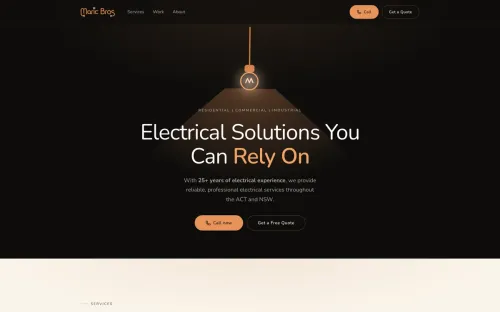
Maric Brothers Electrical is a family electrical business working across the ACT and NSW. Like a plumber, they sell to homeowners and to builders, and like a plumber, the job is won on the phone. Their site pairs click-to-call with a free quote request in the header and footer of every page, so whichever kind of customer arrives, the next step is right there.
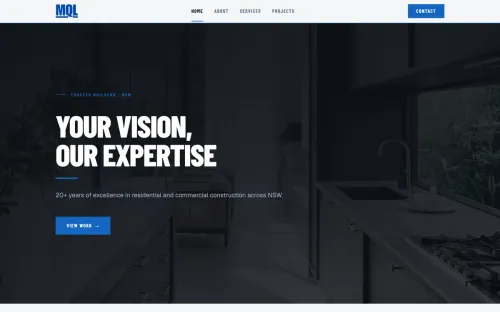
MQL Constructions is a construction company whose clients browse from job sites on patchy mobile connections. The site is hand-coded to load fast on exactly those connections, and past projects are grouped by type so a visitor can find work like theirs without scrolling a long gallery.
Neither of those is a plumber. But the call-first layout, the fast mobile load and the page-per-job-type structure are the same patterns a plumbing site needs, and they’re built the same way.
More on the trade side generally on the tradie web design page, and on local search for Sydney plumbers on the Sydney page.