The website has to work while you’re on the tools
The thing that makes a trade business different from most other clients isn’t the trade. It’s that you’re unreachable for most of the working day. You’re up a ladder, under a house, or in a roof cavity, and the phone is in the ute.
Every website decision follows from that. A form that emails you a lead you’ll read at 7pm is competing against a competitor who answered on the second ring. So the site’s job isn’t only to generate the enquiry. It’s to generate the right kind of enquiry, and to hold the ones you can’t answer immediately.
In practice that means the number is visible and tappable on every screen, but the enquiry form does real work too: it asks the two or three qualifying questions you’d ask on the phone anyway. Suburb, job type, and whether it’s urgent. That way the callbacks you make at the end of the day are to jobs worth driving to, not to someone who wanted a price on something you don’t do.
A website can only hold the enquiries that reach it, though. If you also want missed calls texted back within seconds, every enquiry followed up for you, and a Google review request sent after each job, that’s what the Organic Growth System adds on top of the site.
Why most tradie sites quietly fail
The usual tradie website isn’t badly designed so much as badly aimed. It opens with a photo of a ute and a headline about quality workmanship and 20 years of experience, claims every competitor makes on the same page of results, in almost the same words.
Nothing on it is wrong. It just doesn’t help someone choose. What actually helps them choose is specific: which suburbs you cover, what you charge to come out, whether you’re licensed and insured with the numbers shown, how quickly you can get there, and photos of jobs that look like theirs.
That last one is worth more than any design decision on the page. A stranger judging whether to let you into their house is looking for evidence, and ten real photos off your phone beat any stock image of a toolbox. It’s the single biggest lever most trade sites leave unpulled.
One page per trade, not a services list
Most trade businesses do several distinct things, and most trade websites flatten them into a bulleted list on one page. That’s a ranking problem and a conversion problem at once.
A bullet that says “roof repairs” can’t rank for anyone searching “roof repairs [suburb]”. There’s no page for Google to send them to, and no page for the customer to land on that speaks only to what they need. Split the real services onto their own pages, with genuine detail on each, and the site suddenly has multiple front doors instead of one.
The same applies to service areas. A footer listing thirty suburbs is transparent padding. Two or three areas you genuinely work in, each with real content behind it, does considerably more.
Electrician websites: one site, three kinds of customer
Electrical work is a good example of why a trade site can’t be generic. The same business might wire a granny flat on Monday, fit out a shop on Wednesday and work on an industrial site on Friday. Those are three different buyers, with different questions and different ideas of what makes a sparky trustworthy.
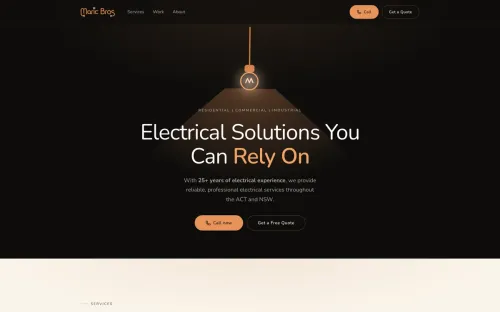
Maric Brothers Electrical is a family business with more than 25 years in the trade, working across the ACT and NSW. Their reputation travelled by word of mouth, but nothing online carried it, so every new enquiry started with a cold phone call. A homeowner wanting a switchboard upgrade, a builder scoping a residential development and a site manager on an industrial job were all landing on the same thin presence.
The site fixes that with structure rather than more words. Past work is catalogued by sector (residential, commercial and industrial), so each kind of customer lands on jobs that look like their own. Every job page carries the real project location instead of a stock caption. And the two actions that turn a visit into work, click-to-call and a free quote request, sit side by side in the header and footer of every page. It’s built to load quickly on the job-site mobile connections that builders and site managers browse from.
If you’re an electrician, the same thinking applies whatever your mix of work. Separate the residential and commercial paths if you do both. Put your licence where people decide, not in the footer. Show finished switchboards, fit-outs and installs from your own phone. And make calling you the easiest thing on every screen.
Different trades, genuinely different sites
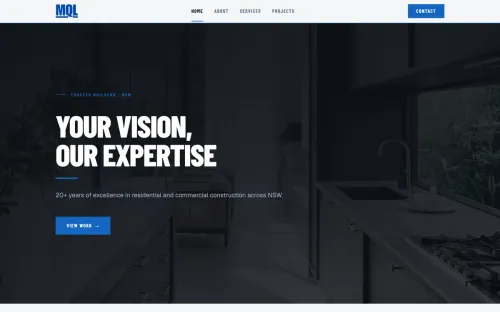
A trade site isn’t one template with a different logo dropped in. A plumber’s site leads with emergency callouts and licensing because a lot of that demand arrives mid-crisis. An electrician’s has to sort homeowners from builders and commercial clients. A builder’s or a construction business’s leads with completed projects, because the sale is slower and the buyer wants proof before a conversation.
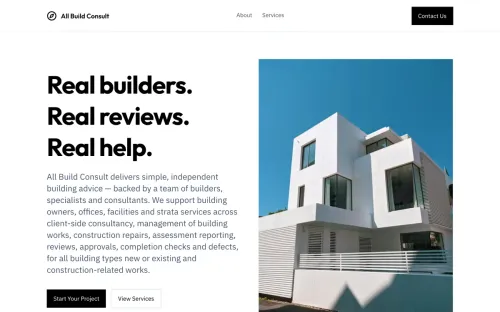
Other trade and construction businesses we’ve built for include MQL Constructions, a construction company with 20 years behind it whose work used to come almost entirely from referrals, and All Build Consult, an independent building consultancy across NSW and the ACT. If you’re a trade in the Canberra region, the Canberra web design page covers the local side.